



Helpful information ...

Moxy Web - Why use API integrations in business?
07.07.2026

Why use API integrations in business?

Find out why you should use API integrations to increase efficiency in your business. Automate processes and focus on growth.

Why Use API Integrations in Business


In brief:

  • API integrations are the technological bridge between systems, enabling the automatic exchange of data. Businesses use them to increase efficiency, reduce errors, and make faster business decisions by connecting ERP, CRM, and e-commerce platforms. Successful implementation depends on choosing the right architecture, ensuring security, and performing regular monitoring.

An API integration is a technical bridge between two or more software systems that enables them to exchange data automatically without manual intervention. For a business owner or IT project manager, this means one practical thing: your systems communicate with each other while you focus on growing your business instead of copying data from one application to another. The reason to use API integrations is simple. Automation through APIs has become the standard for connecting ERP, CRM, and e-commerce systems by 2026, providing real-time data flow and greater business flexibility. Without this foundation, digital transformation remains nothing more than a plan on paper.

What Are the Key Benefits of Using API Integrations in Business?

API integrations eliminate one of the biggest sources of wasted time in companies: manually entering data between systems. When your online store automatically sends an order to your ERP system and your accounting software immediately generates an invoice, you save time and eliminate the risk of human error. This is more than convenience—it's a measurable competitive advantage over businesses that have not yet implemented such automation.

The main benefits include:

  • Time savings: Processes that previously required hours of manual work are completed in seconds.
  • Fewer errors: Automated data transfer eliminates typing and transcription mistakes that are inevitable with manual entry.
  • Faster response to market changes: When inventory, order, and customer data are always up to date, decision-making becomes much faster.
  • Scalability: As your business grows, you simply add another integration instead of replacing your entire system.
  • Greater competitiveness: Companies that exchange information in real time can adapt and innovate more quickly.

The impact on innovation is often underestimated. When teams no longer waste time on administrative tasks, they can focus on developing new services and products. API integrations are therefore more than just an efficiency tool—they are a prerequisite for growth.

Expert tip: Start with the single process that consumes the most time or causes the most errors. A successful first integration will convince the entire team and lay the foundation for future implementations.

Two colleagues working together on API integrations using a computer tablet.

What Types of API Integrations Exist and When Should You Use Them?

Choosing the right type of API integration is a decision that directly affects the reliability of your entire system. The two most common architectures are REST APIs and event-driven integration. Each has its own strengths and ideal use cases.

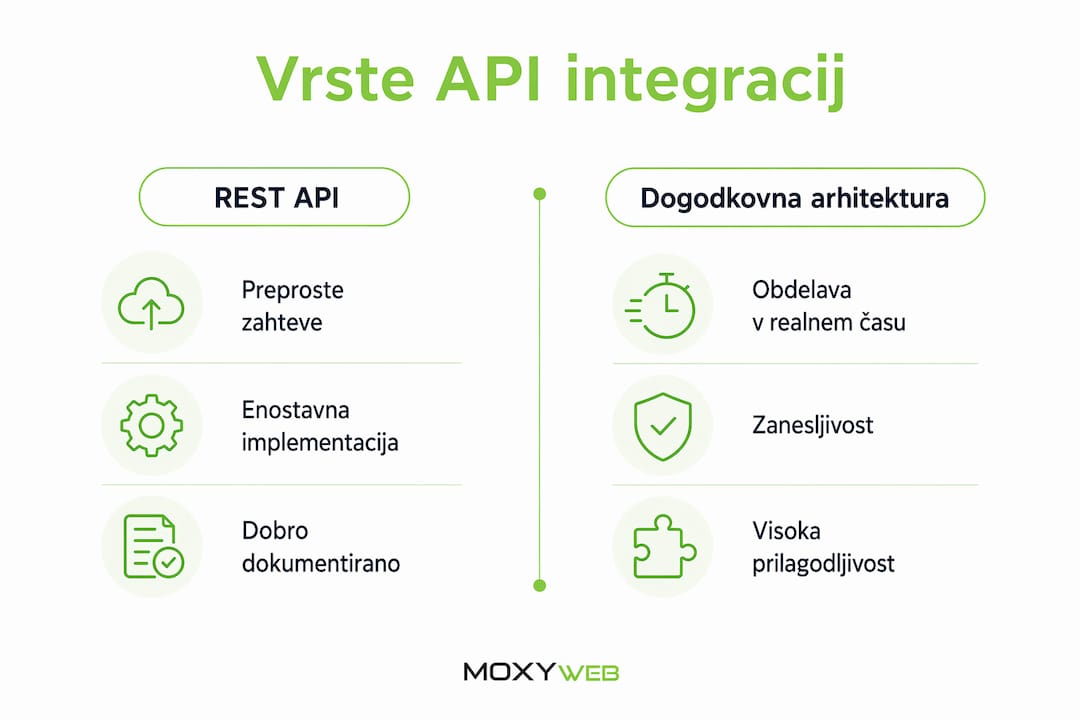
Overview of API integration types and their key benefits in an infographic

Integration Type Best Suited For Advantages Limitations
REST API Simple request-response operations Easy to implement, widely supported Not ideal when systems are temporarily unavailable
Event-driven architecture (message queues) Complex asynchronous processes Messages survive network interruptions Requires more planning and infrastructure

REST APIs are ideal for request-response communication, but they are not the best choice for industrial processes where systems may become temporarily unavailable. In these situations, event-driven architectures using message queues and message brokers are a better solution. This ensures that messages are not lost if the receiving system is offline. Instead, they are stored in a queue and delivered once the system becomes available again.

For most web applications and e-commerce platforms, REST APIs are an excellent choice. They are simple to implement, well documented, and supported by virtually every modern system. For logistics, manufacturing, or financial processes where reliability is mission-critical, an event-driven architecture deserves serious consideration.

Security is essential in both approaches from the planning stage onward. The roles of the data holder, API provider, and data re-user must be clearly defined to ensure GDPR-compliant data sharing. Without this, you risk both security incidents and regulatory penalties.

Expert tip: Before choosing an architecture, ask yourself one question: what happens if the receiving system is unavailable for 10 minutes? If the answer is "nothing good," consider implementing message queues.

How Do API Integrations Impact Business Processes?

API integrations transform the way data flows throughout an organization. Instead of each system operating as an isolated island, all systems become part of a unified digital ecosystem. The benefits become visible almost immediately.

The most significant impacts on business processes are:

  • ERP, CRM, and e-commerce integration: When these three systems are connected in real time, the sales team always has accurate inventory information, while accounting automatically receives everything needed for invoicing.
  • Order and logistics automation: API integrations enable the automated sending and receiving of electronic documents, dramatically reducing processing time and errors in logistics and accounting.
  • Traceability and reporting: When data flows automatically, audit trails become complete. Every transaction is recorded, making internal audits and regulatory reporting much easier.
  • Agile decision-making: Management makes decisions based on data that is seconds old rather than days old.
  • Lower operating costs: Less manual work means lower operational expenses and fewer employees dedicated to repetitive administrative tasks.

A practical logistics example illustrates the value well: when a customer places an order in an online store, the API automatically notifies the warehouse, generates shipping documentation, and sends a confirmation to the customer. All of this happens within seconds, without employee intervention. Such an integration can often be implemented within just a few days using structured documentation and a testing environment.

For IT project managers, it is particularly valuable that artificial intelligence tools can automate data mapping and monitor API call quality in real time. This allows the system to detect anomalies automatically and alert the team before they become serious problems. See examples of web tool integrations for practical real-world scenarios.

What Are the Common Mistakes When Implementing API Integrations?

Implementing API integrations brings clear benefits, but only when approached thoughtfully. Most failures do not stem from the technology itself, but from organizational decisions.

The most common mistakes include:

  1. Implementing too many integrations at once. Experts recommend a phased implementation, focusing on specific recurring problems one at a time. Trying to connect ten systems simultaneously makes the project difficult to manage and significantly increases the risk of errors.

  2. Poor or outdated documentation. An API without good documentation is like a machine without an instruction manual. The team wastes time guessing instead of building.

  3. Ignoring security and GDPR compliance. Security and GDPR compliance should be built into the planning phase, not added afterward. Retrofitting security is more expensive and less reliable.

  4. Inconsistent data formats. Different systems often use different formats for the same data. Without clearly defined data mappings, errors occur that can be difficult to detect.

  5. Lack of monitoring after implementation. An API integration is not a project you deploy once and then forget. Systems are updated and APIs evolve over time. Without regular monitoring, silent failures can occur that only become apparent after the damage has already been done.

Expert tip: Before every integration, define who is responsible for monitoring and maintenance. A technical solution without an owner is a solution that will eventually fail.

To simplify the management of a larger number of integrations, iPaaS solutions and API management platforms are available to centralize monitoring and automate maintenance. These are particularly beneficial for companies with more than five active integrations.

Key Takeaways

API integrations are the foundation of efficient digital business because they eliminate manual work, reduce errors, and provide real-time data for faster decision-making.

Key Point Details
Process automation API integrations eliminate manual data entry and dramatically reduce transfer errors.
Choosing the right architecture REST APIs are sufficient for simple data exchanges, while event-driven architectures are the better choice for reliable industrial processes.
Security and GDPR Build security requirements and GDPR compliance into the planning phase—not afterward.
Phased implementation Start with a single integration that solves a specific problem, then expand gradually.
Post-implementation monitoring Every integration needs an owner and regular monitoring because systems and APIs evolve over time.

API Integrations Are a Business Decision, Not Just a Technical One

When I first worked on a project connecting a client's online store with their ERP system, I expected the biggest challenge to be technical. I was wrong. We completed the technical implementation within a week. The real challenge was convincing management that the integration was worth the investment and aligning teams that had previously worked independently in separate systems.

An API integration is ultimately a change in the way people work, not just a change in technology. Once systems begin communicating automatically, employee roles, information flows, and even organizational culture begin to change. That's a positive development—but it requires preparation.

One lesson I've learned is that companies that successfully implement API integrations all share one characteristic: they have someone who understands both the technical side and the business processes. A pure developer sees only the code. A pure business manager sees only the costs. The person who understands both builds an integration that actually solves the problem.

Security and GDPR compliance are areas where cutting corners is never worth it. I've seen projects where security requirements were added "at the end." The outcome was always the same: more expensive remediation and damaged customer trust. A properly planned integration incorporates security from the beginning, saving both time and money in the long run.

My advice to IT project managers: web automation trends for 2026 clearly point in one direction. Companies that are not building connected digital systems today will be struggling to catch up tomorrow. Start small—but start now.

— Ziga

Moxy-web as Your Partner for API Integration

Moxy-web develops web solutions that are not only visually refined but also technically integrated with your business systems. The Moxy-web team has experience integrating ERP, CRM, and e-commerce platforms through APIs, ensuring that your website or application becomes an active part of your business processes. Every project is approached individually, and together with you we determine which integrations will truly solve your specific business challenges. Whether you operate an online store or are planning to digitize your processes, now is the right time to discuss how business process automation through API integrations can reduce costs and improve efficiency. Visit Moxy-web to discover how we can build a solution that works for you.

Frequently Asked Questions

What Is an API Integration and How Does It Work?

An API integration is a technical bridge between two software systems that enables them to exchange data automatically. One system sends a request, the other responds with data—all without manual intervention.

Why Are API Integrations Important for Businesses?

API integrations eliminate manual data entry, reduce errors, and provide real-time information. This directly improves decision-making speed and operational efficiency.

When Should You Choose a REST API and When an Event-Driven Architecture?

A REST API is ideal for straightforward data exchanges between systems that are consistently available. An event-driven architecture with message queues is a better choice when messages must survive temporary outages of one of the systems.

How Can You Ensure Security in an API Integration?

Build security requirements and GDPR compliance into the planning phase. Clearly define the roles of the data holder, API provider, and data re-user, and regularly review access permissions.

How Long Does an API Integration Take to Implement?

A simple integration with good documentation and a testing environment can often be completed within a few days. More complex integrations involving multiple systems require additional time and careful phased planning.

Recommended Reading

Moxy Web - When does a company need a website redesign?
When does a company need a website redesign? When a website is hindering sales, performing poorly, and not meeting its goals, it's time for a thoughtful redesign.
Moxy Web - Why use API integrations in business?
Find out why you should use API integrations to increase efficiency in your business. Automate processes and focus on growth.
Moxy Web - Trends in business web systems security
Business web security trends show how companies are reducing risks, protecting data, and improving business reliability.
Archive
7. 7. 2026
When does a company need a website redesign?
7. 7. 2026
Why use API integrations in business?
6. 7. 2026
Trends in business web systems security
6. 7. 2026
Why user analytics is important for growth
5. 7. 2026
Business online security without empty promises
5. 7. 2026
How to Set Up Hosting for a Business: Guide 2026
4. 7. 2026
Evaluation of CMS solutions for businesses without fogging
4. 7. 2026
What is Graphic Design: A Guide for Businesses 2026
3. 7. 2026
Hire an agency or develop in-house?
3. 7. 2026
What is a domain and why every business needs one
2. 7. 2026
Why a business needs a web application
2. 7. 2026
Why security updates are important in 2026
1. 7. 2026
Content strategy for a business page
1. 7. 2026
Top 4 agency alternatives for novisplet.com 2026
30. 6. 2026
Does a company need its own CMS?
30. 6. 2026
What is Modern Design: A Guide for Businesses 2026
29. 6. 2026
How to choose the right domain for your business
29. 6. 2026
What is a corporate visual identity: a guide for 2026
28. 6. 2026
Overview of online commerce platforms
28. 6. 2026
How to Design Responsive Websites: A 2026 Guide
27. 6. 2026
How to choose an online store structure
27. 6. 2026
Marketing checklist for a company's digital presence
26. 6. 2026
Best features for a B2B portal
26. 6. 2026
What is User Experience Personalization: A Guide 2026
25. 6. 2026
Shopify or custom store?
25. 6. 2026
Digital Strategy Creation Workflow: Guide 2026
24. 6. 2026
What does custom development mean in practice?
24. 6. 2026
How technical support works: a guide for entrepreneurs
23. 6. 2026
What are design standards: a guide for businesses
23. 6. 2026
How long does it take to create a store?
22. 6. 2026
How to prepare a brief for a website
22. 6. 2026
UX Design Best Practices for Digital Professionals
21. 6. 2026
Business Systems Integration Guide
21. 6. 2026
Workflow for digital company presentation: guide 2026
20. 6. 2026
Best solutions for content editing
20. 6. 2026
Why choose custom development for your business?
19. 6. 2026
Landing page design that sells
19. 6. 2026
Tips for easily managing content in your company
18. 6. 2026
Purchase funnel optimization that sells
18. 6. 2026
Top 6 alternatives to moxy-designs.com in 2026
17. 6. 2026
Top mistakes in website redesign
17. 6. 2026
Top 6 alternatives to mojaspletka.si agencies 2026
16. 6. 2026
What is included in web hosting?
16. 6. 2026
Benefits of scalable applications for growing businesses
15. 6. 2026
Responsive website design without compromise
15. 6. 2026
The Role of Digital Presence for Business Growth 2026
14. 6. 2026
The Role of Automation in Business: A Guide to 2026
14. 6. 2026
Website user experience counts
13. 6. 2026
Tips for improving your digital presence in 2026
13. 6. 2026
How to prepare content for a website
12. 6. 2026
What is website accessibility: a guide for entrepreneurs
12. 6. 2026
Website maintenance for businesses
11. 6. 2026
Benefits of the Modular Web for Businesses in 2026
11. 6. 2026
Trouble-free maintenance of online systems
10. 6. 2026
Step by step: creating a portal for entrepreneurs
10. 6. 2026
A B2B online store that really accelerates sales
9. 6. 2026
The role of digital strategy for business growth in 2026
9. 6. 2026
Managing website content without chaos
8. 6. 2026
What is an e-commerce platform: a guide for businesses 2026
8. 6. 2026
How to connect an online store to ERP
7. 6. 2026
The Role of Fast Page Loading for Entrepreneurs 2026
7. 6. 2026
Guide to redesigning your business website
6. 6. 2026
Content Editing Steps: A Guide for Businesses 2026
6. 6. 2026
How to improve website conversions
5. 6. 2026
Why use an SSL certificate for a secure website?
5. 6. 2026
A booking system that really saves time
4. 6. 2026
The Role of SEO for Businesses: Growth Strategy 2026
4. 6. 2026
How long does it take to develop a web application?
3. 6. 2026
Web Application Development Guide 2026
3. 6. 2026
Payment system integration for online stores
2. 6. 2026
The Role of Analytics in Digital Business: A Guide to 2026
2. 6. 2026
Website or store - what to choose?
1. 6. 2026
GDPR v spletnem okolju: vodnik za podjetja 2026
1. 6. 2026
How is the development of an online store going?
31. 5. 2026
Top 6 how much does it cost to create an agency website 2026
31. 5. 2026
Online Business Automation Trends 2026
30. 5. 2026
The role of artificial intelligence in the web: a guide to 2026
30. 5. 2026
Website Migration Guide
29. 5. 2026
What is front-end development: a guide for 2026
29. 5. 2026
Online User Experience Trends 2026
28. 5. 2026
Website Design: A Guide for Entrepreneurs 2026
28. 5. 2026
Trends in the development of business portals in practice
27. 5. 2026
List of mandatory online store functionalities 2026
27. 5. 2026
When does it make sense to redesign a website?
26. 5. 2026
What is a landing page and why is it key to sales?
26. 5. 2026
How to design a business website
25. 5. 2026
Website Hosting Guide: Choosing and ManagingWebsite Hosting Guide: Choosing and Managing
25. 5. 2026
How to edit content without a programmer
24. 5. 2026
What is UX on the web: a guide for entrepreneurs
24. 5. 2026
WordPress or custom development?
23. 5. 2026
Individual approach in web development: why it matters
23. 5. 2026
Corporate graphic image price: what influences it
22. 5. 2026
A Guide to Website Design in 2026
22. 5. 2026
Creating a custom website pays off
21. 5. 2026
Website Maintenance Process: A Guide for Businesses
21. 5. 2026
The best functionalities of a business online store
20. 5. 2026
Website Creation Checklist: Guide 2026
20. 5. 2026
Creating online stores for businesses
19. 5. 2026
Website Development: A Practical Guide for Entrepreneurs
19. 5. 2026
Business systems integration without chaos
18. 5. 2026
The most common mistakes in developing web solutions
18. 5. 2026
Website support that really works
17. 5. 2026
Examples of aesthetic website design
17. 5. 2026
B2B portal development guide
16. 5. 2026
Definition of Modern Web Development: A Guide for Entrepreneurs
16. 5. 2026
Pre-built platform or custom solution?
15. 5. 2026
Web application scalability: the key to business growth
15. 5. 2026
How to improve website speed
14. 5. 2026
What is web hosting and how to choose the right solution
14. 5. 2026
A guide to a secure business website
13. 5. 2026
Top 10 online trends for businesses: digital growth 2026
13. 5. 2026
A business website that works for a company
12. 5. 2026
Why test online solutions for business success
12. 5. 2026
Choosing an online store platform
11. 5. 2026
Examples of integrating web tools for efficient business
11. 5. 2026
Graphic design for a company that sells
10. 5. 2026
Step by step to successful web application development
10. 5. 2026
UX design of an online store that sells
9. 5. 2026
What is an online store and how to set one up successfully
9. 5. 2026
Graphic design of the overall image
8. 5. 2026
Investing in a website: The key to business growth
8. 5. 2026
Renovate an outdated website without the guesswork
7. 5. 2026
What is a web application and how does it help your business?
7. 5. 2026
How Website Maintenance Works
6. 5. 2026
Effectively Managing Website Content: A Guide for Businesses
6. 5. 2026
Responsive website for business
5. 5. 2026
What is online branding and how does it improve your appearance?
5. 5. 2026
Custom CMS for your business or off-the-shelf solution?
4. 5. 2026
Business Process Automation with a Web Application
4. 5. 2026
Web architecture: the key to a better online presence
3. 5. 2026
Online store integration with delivery
3. 5. 2026
How to design unique online solutions for business growth
2. 5. 2026
Connecting your online store to your accounting
2. 5. 2026
Explaining modern web applications for business growth
1. 5. 2026
What is e-commerce? Everything SMEs need to know to succeed
1. 5. 2026
Corporate Website Security Without Illusions
30. 4. 2026
Top 4 oxmo.si alternatives 2026
30. 4. 2026
Registering a domain name for your business without mistakes
29. 4. 2026
Static vs. Dynamic Website: What It Means for Your Business
29. 4. 2026
Business Website Hosting
28. 4. 2026
Web Design Trends for a Better Digital Presence
28. 4. 2026
Website Maintenance - Price and Reality
27. 4. 2026
How to Build an Online Store
27. 4. 2026
Top 6 mojbiz.si alternatives 2026
26. 4. 2026
What does building a website involve?
26. 4. 2026
Modern Technologies for Successful Web Development and Growth
25. 4. 2026
When is a custom web application the right choice?
25. 4. 2026
8 Benefits of a Modern Online Store for Business Success
24. 4. 2026
How to Optimize Your Website for Better Results
24. 4. 2026
Creating an online store - price without fog
23. 4. 2026
Why Website Speed ​​Is Key to Success
23. 4. 2026
How much does it cost to create a website?